

Product detailed description
⭐️ What makes this tea unique?
✓ The 815 Region is one of the least explored tea-producing areas in Southeast Asia
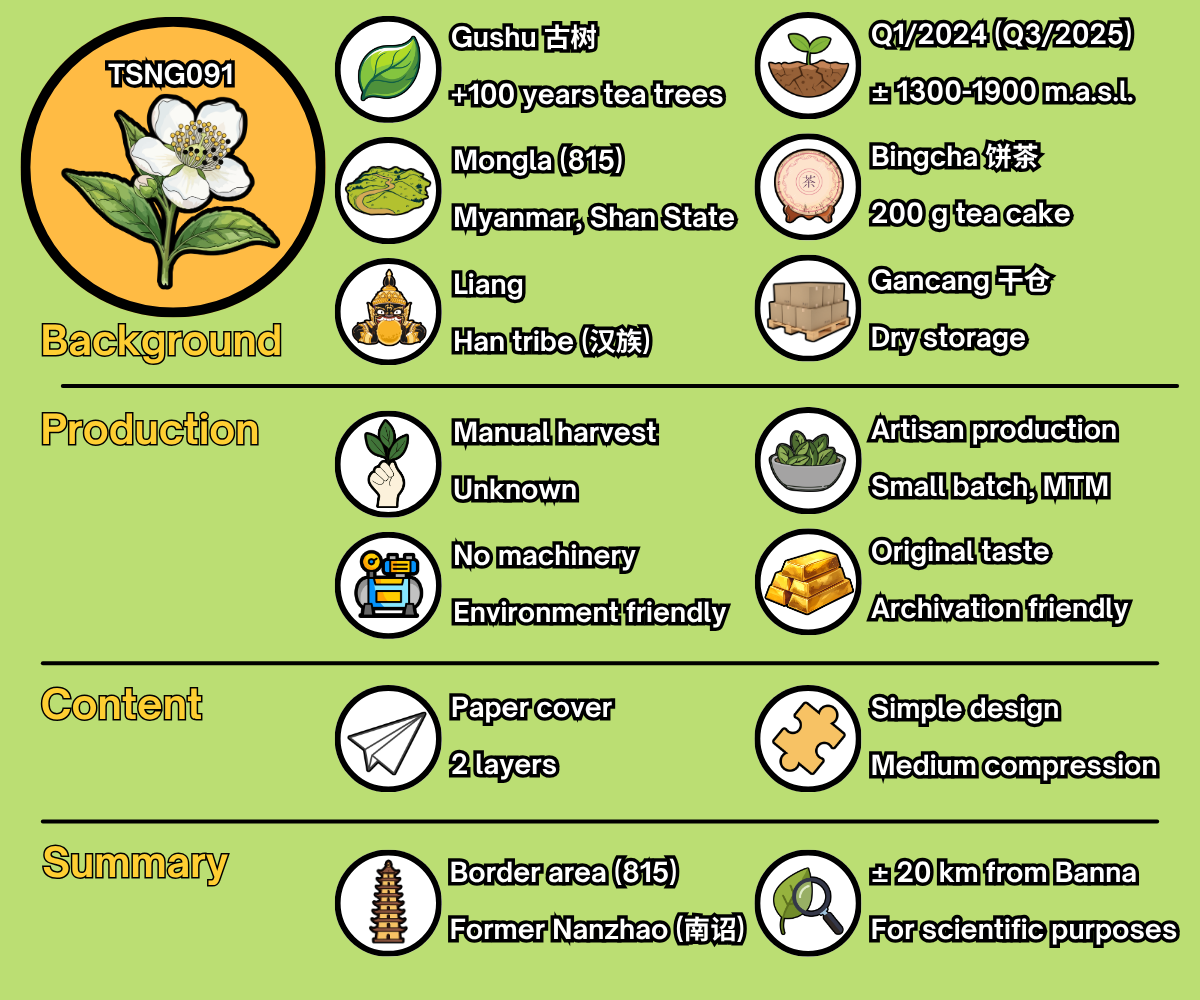
✓ Harvested from ancient tea trees (gushu 古树) over 100 years old, growing only 20 km from Laobanzhang village
✓ Offers a unique opportunity to compare teas from the historical Big Banna region beyond China's borders
🍵 Tea taste profile?
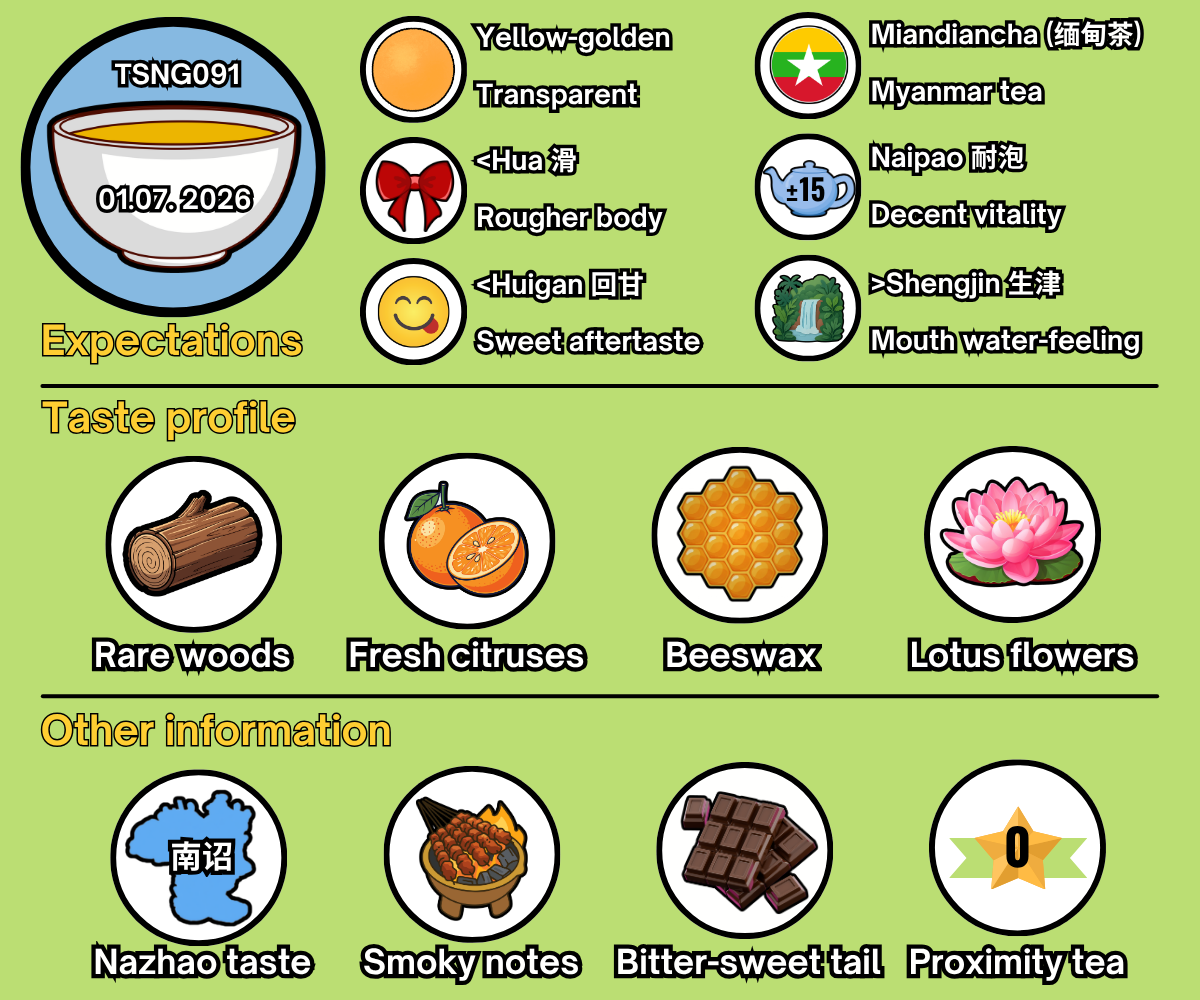
This tea provides a distinctive bitter-sweet experience with notes of rare woods, fresh citruses, beeswax and flowers, accompanied by gentle smoky undertones. Despite sharing some similarities with Bulang Mountain (布朗山), which is located in close distance from the 815 border region, this tea has noticeably slower development, rougher body and more minerally rich aftertaste.
This tea is ideal for enthusiasts of Bulang Mountain teas, comparative tea tastings and the exploration of lesser-known tea regions in Southeast Asia. It was selected primarily for research purposes to better understand various aspects influcing the taste and character of your teas close to Xishuangbanna.
🌏 Tea origin & production?
This recently harvested sheng puer tea originates from one of the least-known tea-producing regions in Southeast Asia—the "815" military area located along the China–Myanmar border between Bulang Mountain and the Eastern Shan State of Myanmar, commonly known as Mongla (勐拉). Although this region lies only about 20 kilometres from Laobanzhang village (老班章) at the borders of Xishuangbanna, it remains virtually unknown to most tea lovers. Due to its long-term militarization, restricted access and limited infrastructure, a completely unique tea realm has developed here, with teas only rarely reaching the European market.
The tea leaves were harvested from ancient tea trees (gushu 古树) over 100 years old, growing across tea gardens covering more than 10,000 mu (approximately 667 hectares) at elevations between 1,300 and 1,900 metres above sea level. The spring harvest of 2024 was carried out in cooperation with local residents and members of the Shan Army, who, in addition to their security responsibilities, have long been involved in agricultural production in the region. The tea was processed under the supervision of experienced tea masters from Xishuangbanna in local Myanmar tea workshops, while the tea compression was finalized in Jinghong city in 2025.
👩🚀 Packing & symbolism?
Although 815 is not the official administrative name of the region, the number is widely used as a popular designation for this militarized area along the China–Myanmar border. One reason is the frequent confusion between the Chinese county Mengla (勐腊) in Xishuangbanna and the Myanmar township Mongla (勐拉ú. For this reason, we placed the number 815 prominently on the tea wrapper. To avoid any ambiguity, we also retained the Chinese geographical designation "Myanmar Mongla (缅甸勐拉)" on the left side of the wrapper.
The astronaut illustrated on the right side of the label symbolizes the exploration of little-documented tea-producing regions, much like the exploration of the unknown universe. It was inspired by The Three-Body Problem (三体) by Liu Cixin (刘慈欣), one of China's most popularized science-fiction novels, which—much like this tea—combines scientific curiosity, exploration and a willingness to venture beyond the boundaries of the familiar.
🫖 Historical background?
Between 738 and 902 CE, the territories of today's Shan and Kachin States in Myanmar used to be part of the Nanzhao Kingdom (南诏), whose territory also included present-day Xishuangbanna as well as some parts of northern Laos and Thailand. As a result, many tea-producing regions continue to share similar natural environments and cultural traditions despite now belonging to different countries.
For this reason, we included this tea in our Xishuangbanna Proxima project, which introduces historically connected tea-producing regions surrounding the former territory of Big Banna. It offers a unique opportunity to compare teas across both the historical and modern boundaries of Xishuangbanna and better understand how tea geography influences the final drinking experience.
🎎 How did we obtain this tea?
One of the core principles of Banna House is traceability of origin. We obtained this tea directly from Ms. Liang, a certified tea master (Shenzhen, 2013), experienced instructor and mentor who has been teaching at Xishuangbanna Jinlanling Vocational Training School (西双版纳金蓝领职业培训学校) since 2019. Although Ms. Liang primarily specializes in teas from Xishuangbanna, her extensive local network has enabled us to expand our tea collection from the adjacement regions of Big Xishuangbanna.
During our research trip to Xishuangbanna in 2025, we evaluated dozens of tea samples from border regions, discussed their production techniques and conducted numerous interviews on current developments within the regional tea industry. Thanks to this long-term collaboration, we are able to offer not only the tea itself, but also verified information about its origin, production methods and broader historical context.
🌱 Want to know more?
Check out our tea scientific summaries bellow and other infographics in the product bookmarks. Did you find some typos or errors? Contact us on info@bannahouse.cz
This tea is part of the Xishuangbanna Proxima project under the auspices of the Czech-Xishuangbanna Tea Association (CZEXITEAS), which aims to collect teas and information about Xishuangbanna neighborhood regions with shared history and culture. The data were retrieved from field research, interviews and consultations with producers as well as other experts on regional tea development in Xishuangbanna.
Additional parameters
| Category: | Teas |
|---|---|
| Distributor & Producer: | Liang |
| Tea mountain & region: | Myanmar Mongla 缅甸勐拉 |
| Year of production & compression: | 2026-2021 |
| Tea form & packing: | Compressed tea (紧压茶) |